
Preventive care at Co-Ordination
The annual check-up provides important insights into your overall health. This way, chronic diseases can be detected early on, and potential risk factors can be minimized through appropriate measures. Early detection of diseases can improve your chances of recovery and prevent conditions such as colorectal cancer, heart attack, high blood pressure, and the progression of skin cancer.
Our focus on preventive examinations is on cardiovascular and cancer diseases, which are among the most common causes of death nationwide. A preventive examination with us includes the following specific examinations:
Cardiological evaluation
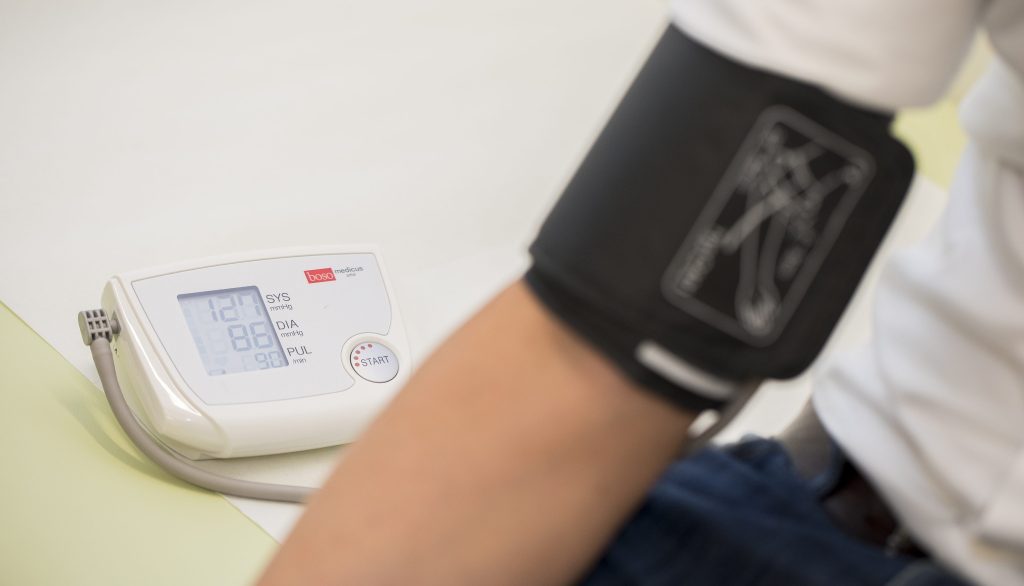
High blood pressure (arterial hypertension) is a widespread condition and, according to estimates, affects almost a quarter of all adults in the United Kingdom. Patients over the age of 50 are affected even more frequently. The significance of high blood pressure lies primarily in its role as a trigger for conditions such as heart attack, atrial fibrillation, or stroke.
see more
High blood pressure can have many different causes: Lack of exercise, chronic Stress, too much Salt consumption, unhealthy nutrition, obesity, smoking or family risk. In addition, a Malfunction of the kidneys or thyroid gland must be ruled out, as these causes require different treatment. All these factors contribute through a complex system to the narrowing of the arteries – the vessels that transport blood from the heart to the other organs. The heart has to pump against narrowed arteries (increased resistance), leading to an increase in blood pressure. Medications aim to expand these constricted blood vessels again. However, this only succeeds for 12 to 24 hours. Then the vessels would narrow again. That’s why regular tablet intake is crucial. The actual cause is unfortunately not addressed by the medications.
Other useful tests for an accurate diagnosis of high blood pressure include heart ultrasound, carotid duplex, ECG, ergometry and laboratory tests.
As a precautionary measure, I often examine the blood vessels of younger people in my practice who are not actually patients, but are simply coming in for a routine check-up. The results are often unexpected, as I repeatedly find vascular changes in the form of wall thickening (the precursors to so-called plaques or calcifications) even in 40-year-olds. But is that really so surprising?” Priv.Doz. Dr. Stefan Pfaffenberger
There is now sufficient data to prove that the vascular wall changes that ultimately lead to heart attacks or strokes develop slowly and predictably over decades, and that it is no coincidence who ultimately suffers from such a disease at the age of 70. According to Statistics Austria, around 43% of Austrians died of cardiovascular causes (i.e. mainly heart attacks and strokes) in 2016.
Early changes in the blood vessels can often be observed as early as 30 years beforehand, or even earlier.
One should also keep in mind as a young person that they can be affected and should undergo a medical check-up in a timely manner. Risk factors like high cholesterol can already be present in adolescents. High blood pressure often comes with a stressful professional life or, in women, frequently accompanies menopause. Life has become very fast, too fast. Some compensate for this with Nicotine or alcohol. Important family obligations prevent regular physical activity in leisure time. Nutrition also plays a significant role. You should not ignore risk factors. Get your blood vessels checked, better late than never. If there are vascular changes, you should analyze your risk factors with your doctor.
Your doctors for cardiological care
The goal of colorectal cancer screening is the early detection of polyps (adenomas) in the colon, which can develop into colorectal cancer.
see more
The purpose of colorectal cancer screening or “colorectal cancer prevention” is to detect and remove polyps or adenomas in the colon, as these polyps can later develop into colorectal cancer. Statistically, one in four individuals over the age of 50 has such polyps.
Colonoscopy is the most effective cancer prevention method of all. That has essentially 2 reasons:
Firstly, it takes a relatively long time for a polyp to develop into colorectal cancer. This provides a large time window to detect any polyps during colorectal cancer screening.
Secondly, when polyps are detected, they are promptly removed during the screening process. That means, the risk factor of having a polyp or adenoma is not only identified but also immediately eliminated.
From the age of 50 onwards, a preventive colonoscopy is recommended for everyone. If there are cases of colorectal cancer in the family, a preventive colonoscopy is recommended even before the age of 50. Various factors play a role in this. We are happy to advise you on this in Co-Ordination.
The Co-Ordination holds the Quality Certificate for Colorectal Cancer Prevention from the Austrian Society for Gastroenterology and Hepatology (ÖGGH).
www.vorsorgekoloskopie.at
Ihre Ärzte zur Vorsorgecoloskopie
Skin cancer prevention
Melanoma is one of the cancers with the fastest growing rates of new cases. More and more young adults are also being affected by it.
Here the rule is: the earlier the diagnosis, the better the prognosis.
see more
In the early stages, melanoma can be cured by simple excision under local anesthesia. The longer melanoma has to grow, the more likely it is to spread and form life-threatening secondary tumors (metastases) throughout the body.
Skin cancer screening includes the assessment of the entire skin from head to toe. Even without specific devices, an experienced dermatologist can identify suspicious skin changes with the naked eye. In this process, an epiluminescence microscope (also called dermatoscope) is often used for the early detection of melanoma and other types of skin cancer.
Risk factors:
(1) Changes in a mole: If a mole changes in shape, color, or size, a medical examination is recommended promptly.
(2) Family history: Two or more people in your family have a histologically confirmed melanoma.
(3) Many moles: The more moles a person has, the higher the risk of melanoma.
Ihre Ärzte zur dermatologischen Vorsorge
Urological prevention (from the age of 45)
Urological problems are often insidious because they may not leave noticeable traces for a long time. Men should be aware that every stage of life entails urological risks. For example, testicular cancer in young males, erectile dysfunction and prostate cancer in older males, bladder distension due to prostate enlargement, and so on.
see more
Urologists have solutions for many problems that were previously unthinkable. However, most measures are much more effective in the early stages of a disease. To recognize that, you need a professional and not the currently popular self-diagnoses on the internet.
From the age of 45, every man is recommended to undergo annual urological preventive examination. In cases of genetic predisposition, this is even recommended from the age of 40.
But young men should also go for regular check-ups with the urologist to detect and treat diseases of the testicles, bladder, or urethra in a timely manner. A simple ultrasound examination of the testicles can prevent later infertility or diagnose testicular cancer in the early stages.
Urological examinations used to be uncomfortable to painful. That was 20 to 30 years ago! With the invention of technologies like ultrasound, a new era has begun, and our patients are often pleasantly surprised during their visits to our practice.
Your doctors for urological screening
Schedule an appointment

Tel. appointment scheduling
Monday:
Tuesday:
Wednesday:
Thursday:
Friday:
9:00 a.m. to 7:30 p.m.
9:00 a.m. to 7:30 p.m.
9:00 a.m. to 7:30 p.m.
9:00 a.m. to 7:30 p.m.
9:00 a.m. to 2:00 p.m.